What kind of education in the age of artificial intelligence?
UIT and the Tunisian Forum for Knowledge open the debate on the future of teaching
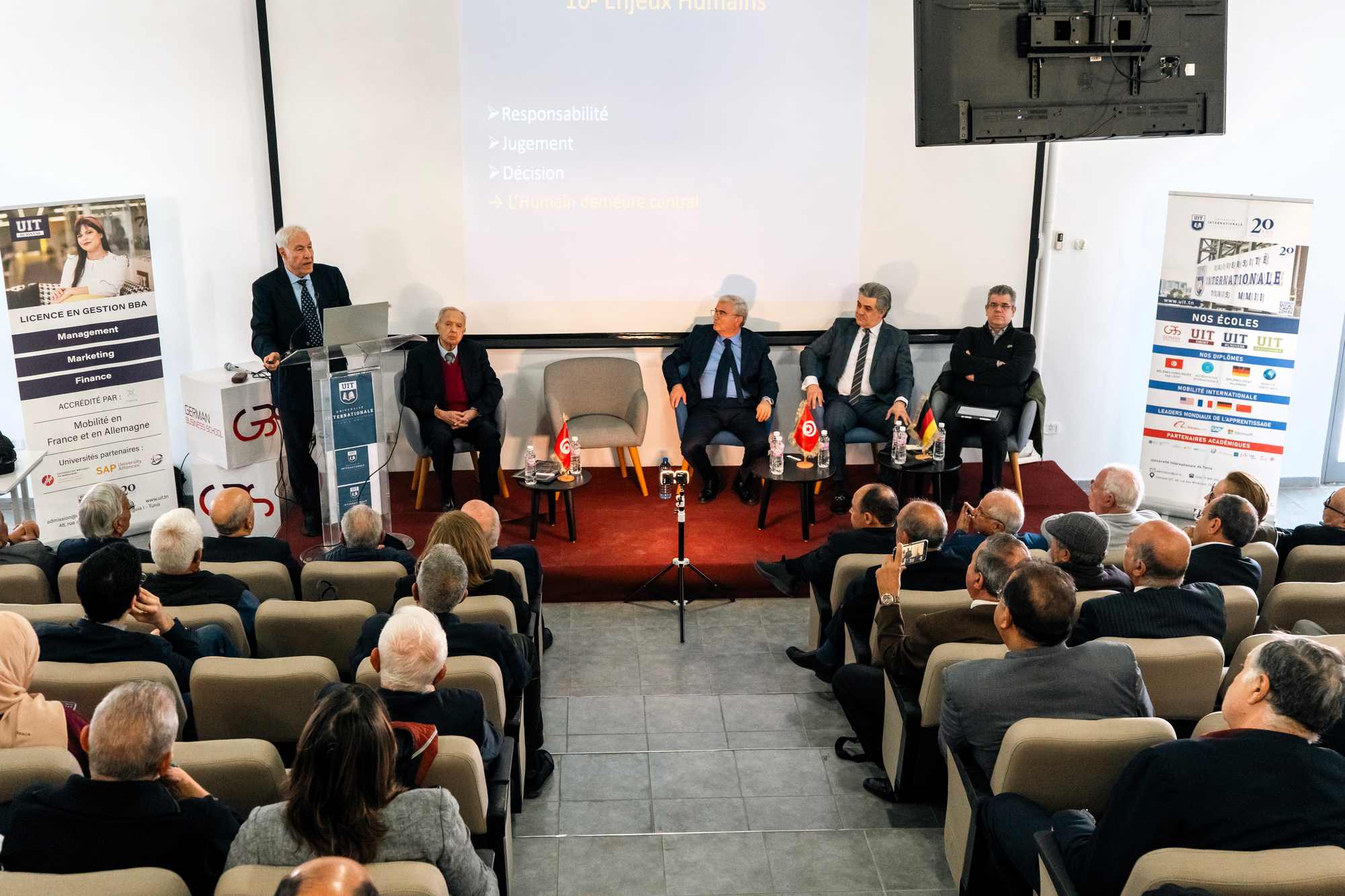
The International University of Tunis hosted, in co-organization with the Tunisian Forum for Knowledge and Human Development, a major conference-debate dedicated to one of the most defining questions of our era. Academics, executives, teachers and students gathered to explore the profound transformations that AI is imposing on educational systems — and on the institutions that carry them.
A question that is no longer about the future, but about the present
In his opening remarks, Maher Tebourbi recalled that the topic is no longer a forward-looking hypothesis but a pedagogical emergency: AI is reshaping, here and now, the way knowledge is transmitted, skills are assessed, and professional pathways are built.
The panel convened to lead this reflection brought together leading figures: Professor Ahmed Friaâ, President of the Tunisian Forum for Knowledge and Human Development, mathematician and engineer of the Ponts et Chaussées, former director of the National School of Engineers of Tunis (ENIT), former Minister of Education and Sciences and then of Communication Technologies, whose work on the viscoplastic constitutive law — known today in international scientific literature as the Norton-Hoff-Friaâ law — earned him the International Prize of Scientific Excellence; His Excellency Habib Ben Yahia, a graduate of Columbia University (New York) in international relations, former Minister of Foreign Affairs and former Minister of National Defense, former Ambassador of Tunisia to Belgium and then to the United States, and former Secretary General of the Arab Maghreb Union; Professor Samir Ben Ahmed, General Academic Director of UIT, architect in Tunisia of the integration of the LMD system and former director of INSAT and the Higher Institute of Computer Science; as well as Dr. Sami Bahri, associate teacher-researcher in the executive programs of the German Business School.
From scarcity to abundance: a civilizational shift
Professor Ahmed Friaâ opened his intervention with a deliberately classic image: the master's chair. Replace the chair with a podium, add a blackboard, and you have the classroom of Tunis, Paris, New York or the depths of Africa. This model, he explained, rested on a simple premise: knowledge was scarce, and the master was its keeper.
This premise has collapsed. Drawing on the work of systems theorist Alvin Toffler, the speaker recalled the dizzying acceleration of the volume of human knowledge:
18 Centuries (100 → 1700) | 2 Centuries (1700 → 1900) | 60 Years (1920 → 1960) | Days Today in the age of AI |
Direct consequence: the scarcity of knowledge has given way to its abundance. But this abundance creates in turn a new scarcity — that of good answers, of discernment, of judgment.
"We are moving from a logic of access to knowledge to a logic of exploitation of knowledge."
AI: algorithms, data, and a Tunisian blind spot
Returning to the technical foundations of artificial intelligence, the speaker insisted on the deeply mathematical character of the discipline: algorithms, statistics, probabilities, graph theory.
"Without mathematics, there is no artificial intelligence."
Yet Tunisia today has barely 7% of students oriented toward mathematical specialties, while other countries invest massively in scientific fields — with ratios that can reach 30%. The parallel was extended to China, whose meteoric rise — moving in a few decades from the "rice bowl" problem to the status of the world's second-largest power — is, according to the speaker quoting a speech by Valéry Giscard d'Estaing, due to the privileged place of the engineer in society.
The intervention also recalled an often-forgotten element of Tunisian scientific history: as early as 1986, the Faculty of Sciences of Tunis was already interested in artificial intelligence. A poster from the period bears witness. How can these achievements be transformed into a sustainable trajectory?
"Great nations have a culture of accumulation: each generation makes its contribution, and layer after layer, the country becomes a true technological and economic power."
The challenge for Tunisia lies precisely there: to capitalize on its achievements, to build on what exists, and to inscribe each new step in the continuity of the previous ones. It is this logic of accumulation — at work in the most efficient scientific ecosystems in the world — that the university, training institutions and public actors are called upon to adopt collectively.
Educate or train: the mission shifts
The reflection then focused on the distinction between transmission of knowledge and training. The first aspect — having students assimilate a body of content — loses its centrality as AI makes that content immediately accessible. The second aspect becomes decisive: learning to act, to question, to decide, to validate.
"Penalizing a young person because they make a mistake in calculating an integral is no longer the right approach. Calculation is now within everyone's reach. What matters is their ability to exploit what they have learned."
The pedagogical shift is clear: from memorization and recitation, towards understanding, evaluation, judgment and validation.
The new skills of the 21st century
From this analysis flows a demanding set of requirements for schools and universities:
- ▸ Knowing how to ask the right questions — because a bad question to the AI produces a bad answer.
- ▸ Developing critical thinking — the AI's response is a possibility, never a truth.
- ▸ Acquiring a deep understanding of the problems addressed.
- ▸ Mastering the exploitation of knowledge, and not its mere accumulation.
- ▸ Cultivating sound judgment, the only safeguard against the illusions of automation.
This is what the speaker called the "competition of intelligences" — this new front line where the competitiveness of nations and companies is now being decided.
The illustration was as concrete as it was revealing. Imagine entrusting an AI with the design of a road interchange without informing it that a tramway line runs nearby. The machine will produce a perfectly coherent sizing in geometric and structural terms. But it will ignore a decisive phenomenon: stray currents induced by the passing tramway will, over time, cause the corrosion of the reinforced concrete bars — a silent degradation that directly threatens the durability of the structure and, ultimately, the safety of users.
Human intelligence remains the one that sets the context, identifies what the machine ignores, and pinpoints the missing data on which the lifespan of a structure sometimes depends.
UIT in motion: programs already underway
Beyond the debate of ideas, this conference is part of an operational dynamic already engaged by UIT and the German Business School:
AI-Enhanced Project Manager
First session of the executive program combining project management and artificial intelligence applied to business, already launched with a first cohort.
AI for Educators
Workshop scheduled for May 6 for training and education organizations, to concretely support the pedagogical transformation discussed at the conference.
A dialogue to be continued
In closing, participants converged on one observation: the question is no longer whether AI will transform education, but to what depth and according to which values. UIT and the Tunisian Forum for Knowledge and Human Development intend to continue this dialogue, convinced that it engages, beyond the school, Tunisia's capacity to weigh in the global competition of intelligences.
International University of Tunis — in partnership with the Tunisian Forum for Knowledge and Human Development