Health in the era of Artificial Intelligence
Dr. Moez Ben Ali lays, at UIT, the foundations of a new medicine
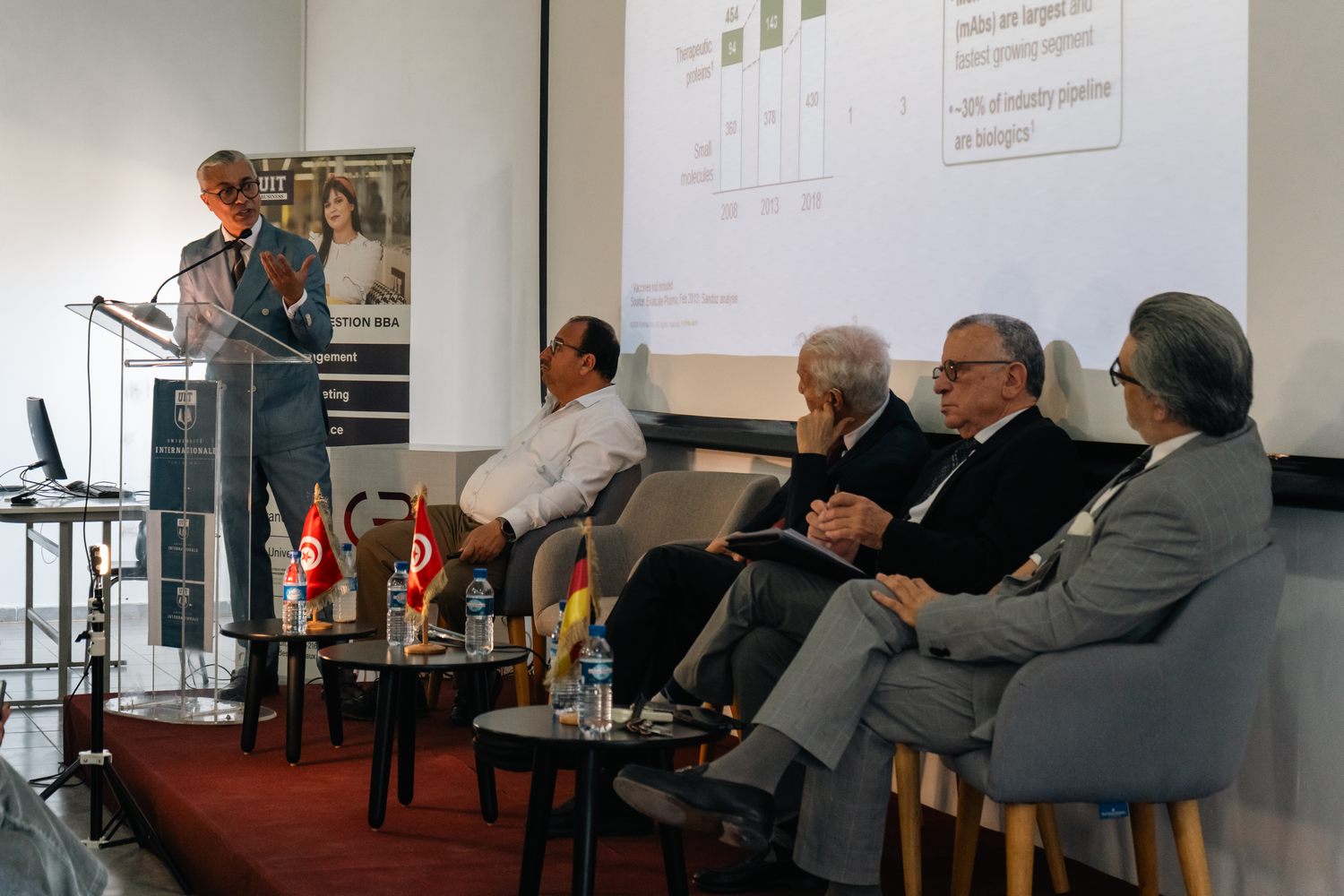
The International University of Tunis hosted, in co-organization with the Tunisian Forum for Knowledge and Human Development, the second installment of a cycle of conference-debates dedicated to the transformations that artificial intelligence imposes on the structural sectors of Tunisian society. After a first session devoted to education, it is now healthcare that was at the heart of discussions — a field where technologies are simultaneously disrupting medical practice, ethics, access to care, and the economics of medicine.
A question that no longer waits
In opening, Maher Tebourbi (opens in a new tab) recalled the ambition of the cycle: to make UIT a space for structured debate on the challenges of AI in all structural domains. Professor Ahmed Friaâ (opens in a new tab), President of the Tunisian Forum for Knowledge and Human Development, emphasized that Tunisia has solid assets in this field — assets forged by a sound health policy built since independence, and by pioneering digital advances that place the country among the first in the world to have adopted the Internet, as early as 1995.
The keynote speaker, Dr. Moez Ben Ali, oncologist and doctor in molecular biology, is one of the world's leading specialists in the development of anticancer drugs. He has held key positions in several major international pharmaceutical firms — Johnson & Johnson, GSK, Bristol-Myers Squibb, SOBI, Novartis Oncology — and now sits on several international cooperative groups as well as on the scientific body of the FDA. His team participated in the development of the world's first CAR-T therapy, the first truly curative treatment of cancer, approved by the FDA in September 2017.
The audience also included His Excellency the Ambassador of Mali, former Minister of Health, Pr. Ridha Kechrid, as well as a broad gathering of academics and practitioners.
A revolution that did not start yesterday
First message, head-on: artificial intelligence in healthcare is not a recent phenomenon. Since the 1990s, under the name of computer-aided drug development, algorithms were already processing the massive volumes of genomic data that researchers could not analyze alone. The current rupture is part of the continuity of a long technological trajectory — and Tunisia has played, on several occasions, a pioneering role that few still measure. A particular tribute was paid, on this occasion, to Professor Ahmed Friaâ himself, whose personal commitment was part of the driving forces of the Tunisian digital breakthrough from the 1990s.
"In the United States, in France, all around the world, ministries have changed their names after Covid: we now speak of 'Health and Prevention'. This is not a semantic detail. It is a paradigm shift."
Healthcare system or care system?
Dr. Ben Ali engaged in an uncompromising diagnosis of the evolution of the Tunisian medical model. An excellent health policy had been put in place from the 1960s. But progressively, the country drifted away from this vision toward a care system — a system that treats already-established disease, rather than a system that prevents, anticipates and cures. This drift is not specific to Tunisia: it reflects a global choice of modern medicine, which AI could precisely reverse.
The silent crisis of Evidence-Based Medicine
The tone hardens when the speaker addresses the dominant dogma of contemporary medicine: evidence-based medicine. Far from being the gold standard it is presented as, it suffers, data to support, from major methodological and ethical flaws:
- Phase I trials determine a maximum tolerated dose — never the optimal dose for each patient.
- Patients included in clinical trials do not resemble the real patients treated in routine practice (age criteria, comorbidities, ethnicities).
- Doctors, poorly trained in pharmacology, apply recommendations derived from populations that do not reflect human diversity.
The illustration was striking: a recent study conducted by Benjamin Besse showed that with half the recommended dose of pembrolizumab — an immunotherapy priced at €4,200 per month — the results were superior, simply because toxicities decreased and treatment sessions no longer had to be postponed.
"Ethically, this methodology is aberrant. It does not respect the first principle: the benefit must outweigh the risk for the patient."
From personalized medicine to precision medicine
Personalized medicine, which appeared in the 2000s, was a partial promise. Precision medicine, on the other hand, opened up by high-throughput genomic sequencing and AI, targets the deep molecular cause rather than the symptoms. The most emblematic example remains that of CAR-T cells, the first truly curative cancer treatment.
"We take the patient's lymphocytes, we genetically modify them so that they recognize tumor cells, we reinject them. The patient becomes their own laboratory."
The initial cost of CAR-T in the United States was around $1.1 million. In Spain, thanks to in-hospital manufacturing, the same treatment is now available for €80,000. The lesson is clear: innovation, when embraced early, brings costs down — it does not raise them.
Health data: the new global raw material
The most striking moment of the conference focused on the strategic nature of health data. Raw data, in itself, has no value. What has value is data structured according to a rigorous scientific protocol, with a precise clinical objective and ethical traceability. This is what the international community calls Real-World Evidence, as opposed to mere Real-World Data.
"Health data has no value in itself. What has value is the evidence — that is, data collected according to a precise scientific protocol."
On the global market, the data of a single properly-structured patient trades around €5,000. Dr. Ben Ali confided to the audience that his own company had just acquired a player based in Sophia Antipolis for €7.6 million — solely for its databases. The message to Tunisia is unambiguous: do not repeat with data the mistake made for 70 years with medicine, where the country has confined itself to producing generics without ever building a real industry of innovation.
African genomic diversity: a strategic asset
For two years now, the FDA has imposed a diversity law: no drug can now be approved without clinical trials having included populations representative of all human ethnicities. Yet existing databases — American, European, Chinese — suffer from a critical deficit in diversity. And a major scientific finding emerges: Africa is the only continent in the world where genomic diversity is sufficient to meet this requirement. Between Tunisia and Morocco, between Sudan and Mali, the genomic gaps are considerable.
"The future of health will be in Africa. And I refuse for Africa to be exploited like an oil deposit. Fortunately, it is a gene deposit — a gift that God has placed inside our DNA. No one can steal it from us remotely."
The opportunity drawn is immense: Tunisia can become the continental hub for Intelligence-Based Medicine, by collecting, structuring and valorizing African data according to the most demanding international standards.
The doctor of tomorrow: a return to science
Throughout the intervention, another red thread emerged: the redefinition of the medical profession. Before the 19th century, the doctor was a scholar — Pasteur, Fleming were researchers before being clinicians. It was mass medicalization that progressively distanced practitioners from the fundamental sciences. In the era of AI, this divorce becomes an existential risk.
"Tomorrow, it will no longer be the clinician who prescribes. The doctor who is not a scientist will no longer be able to exist. And the dispensing pharmacist, if they do not become a true pharmacologist, will disappear."
AI does not replace the doctor — it unburdens them. With digital twins, it relieves the doctor of technical knowledge to give back what medicine had lost: the time to think, the time to research, the time to innovate. Among the most striking examples mentioned: chronotherapy, developed notably by Professor Francis Lévi. Forty-seven retrospective studies have proven that immunotherapy is only fully effective if administered after 3:00 p.m., when the immune system is at its peak of activity.
Toward Intelligence-Based Medicine
Dr. Ben Ali campaigns, on an international scale, for the transition from Evidence-Based Medicine to Intelligence-Based Medicine. With the support of WHO, he leads a program called "Cancer Zero". According to current technological projections shared in the main global scientific circles, people who do not die between 2030 and 2035 could live up to 150-160 years, with a healthy body. The technology is ready. Regulation is gradually aligning.
"What is missing is neither the tools, nor the science. It is the political decisions."
To the question — raised by several speakers — about Tunisia's national strategy in matters of AI and health, the answer was direct:
"Tunisia has no strategy. And maybe that's just as well. Because before strategy, a vision is needed. Vision is for the great. Strategy is for the small. Tunisia has built only one vision in its modern history: the national school of the 1960s. It is time to build a second one."
UIT on the move: upcoming events
Beyond the debate of ideas, this conference is part of an operational dynamic already underway by UIT and the German Business School. Next Tuesday, May 6, UIT will host two complementary events dedicated to artificial intelligence:
Exploring AI: Scientific Production & Ethical Challenges (opens in a new tab)
Academic symposium bringing together researchers and practitioners around the major questions raised by the rise of AI in the production of scientific knowledge and its ethical implications.
AI for Educators (opens in a new tab)
Workshop organized by the German Business School, dedicated to teachers and educational stakeholders called upon to integrate AI into their teaching practices.
A dialogue to continue
In closing, the exchanges converged on a certainty: Tunisia has unique assets — genetic, intellectual, historical — which it can only develop through a bold political vision, renewed scientific courage, and a refounding of the dialogue between medicine, fundamental sciences and technology. The door through which to enter tomorrow's world is open. It remains to dare to cross it.
International University of Tunis — in partnership with the Tunisian Forum for Knowledge and Human Development